
The advice is everywhere: don’t leave your phone charging overnight, you’ll damage the battery. People repeat it with confidence. The problem is that it’s based on how phones worked roughly a decade ago, and it doesn’t describe modern devices at all.
What used to be true—and why
Early lithium-ion batteries in consumer devices didn’t have sophisticated charging management. Leaving them at 100% for extended periods did cause what’s called “high state of charge stress”—the battery degraded faster when held at maximum voltage continuously. The advice made sense at the time.
What actually happens now
Both Apple and Google introduced intelligent charging management several years ago, and it’s been standard across modern devices since around 2019-2020.
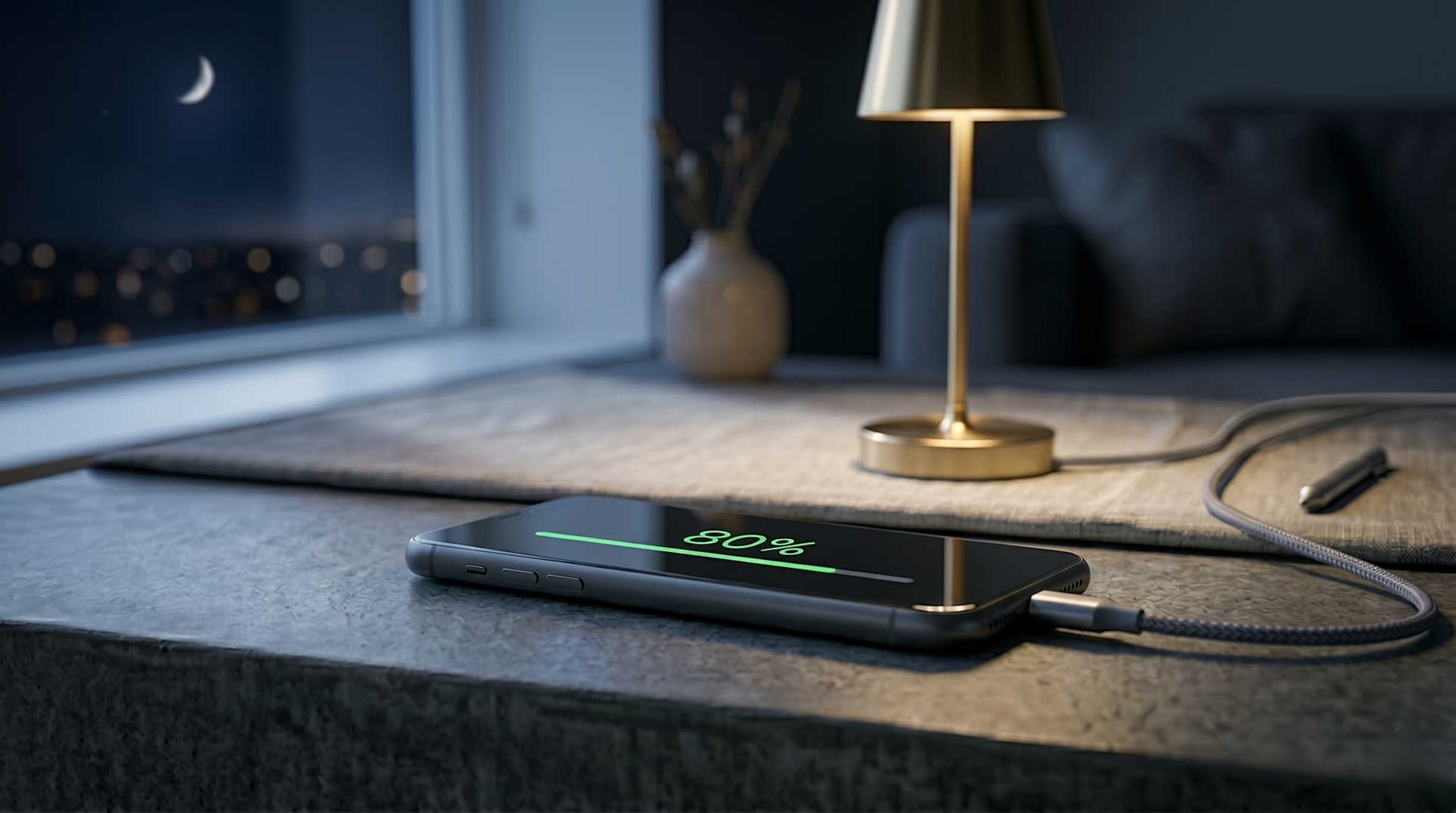
On iPhone, it’s called Optimized Battery Charging and has been available since iOS 13. The phone uses on-device machine learning to analyze your daily routine—specifically when you typically sleep and wake up. Based on this, it charges to 80%, deliberately pauses, and then calculates when to complete the final 20% so the battery reaches 100% shortly before you’d typically pick it up. The phone is never sitting at 100% all night. It’s at 80%, doing nothing, for most of the time you’re asleep.
On Android, the equivalent feature is called Adaptive charging (Pixel), Adaptive battery or Optimized charging (Samsung), or similar names depending on the manufacturer. The behavior is essentially identical—the same learn-your-schedule, pause-at-80%, finish-before-morning approach.
How to verify it’s on
These features should be enabled by default, but it’s worth confirming.
iPhone: Settings → Battery → Battery Health & Charging → Optimized Battery Charging → On
Samsung: Settings → Battery → More battery settings → Adaptive charging → On
Pixel: Settings → Battery → Adaptive charging → On
Other Android: search “adaptive charging” or “optimized charging” in your Settings search bar
What actually damages phone batteries in 2026
The overnight charging myth persisting means some of the real culprits get less attention.
Heat is the primary enemy of lithium-ion battery longevity—significantly more impactful than charging patterns. Charging a phone while it’s inside a case that traps heat, leaving it in a hot car, or using it while gaming while it charges are all more harmful than any overnight charging scenario. Notably, charging under a pillow is genuinely a problem—not because of the overnight duration, but because it traps heat.
Consistently running to 0% before charging is a real stressor on modern lithium-ion cells. Occasional deep discharge isn’t harmful, but doing it regularly accelerates degradation. The 20-80% range is genuinely better for battery longevity, though most people don’t need to be obsessive about it.
Cheap or uncertified charging cables deliver inconsistent voltage and current, which causes repeated micro-stress cycles on the battery controller. Using the cable that came with the phone, or a certified third-party alternative, is worth doing.
The short version
Overnight charging with Optimized Charging enabled: fine. Your phone has been handling this automatically for years. Check that the feature is on, keep the phone out of heat while charging, and avoid habitually running it to 0%. That’s the actual battery health advice for 2026.