
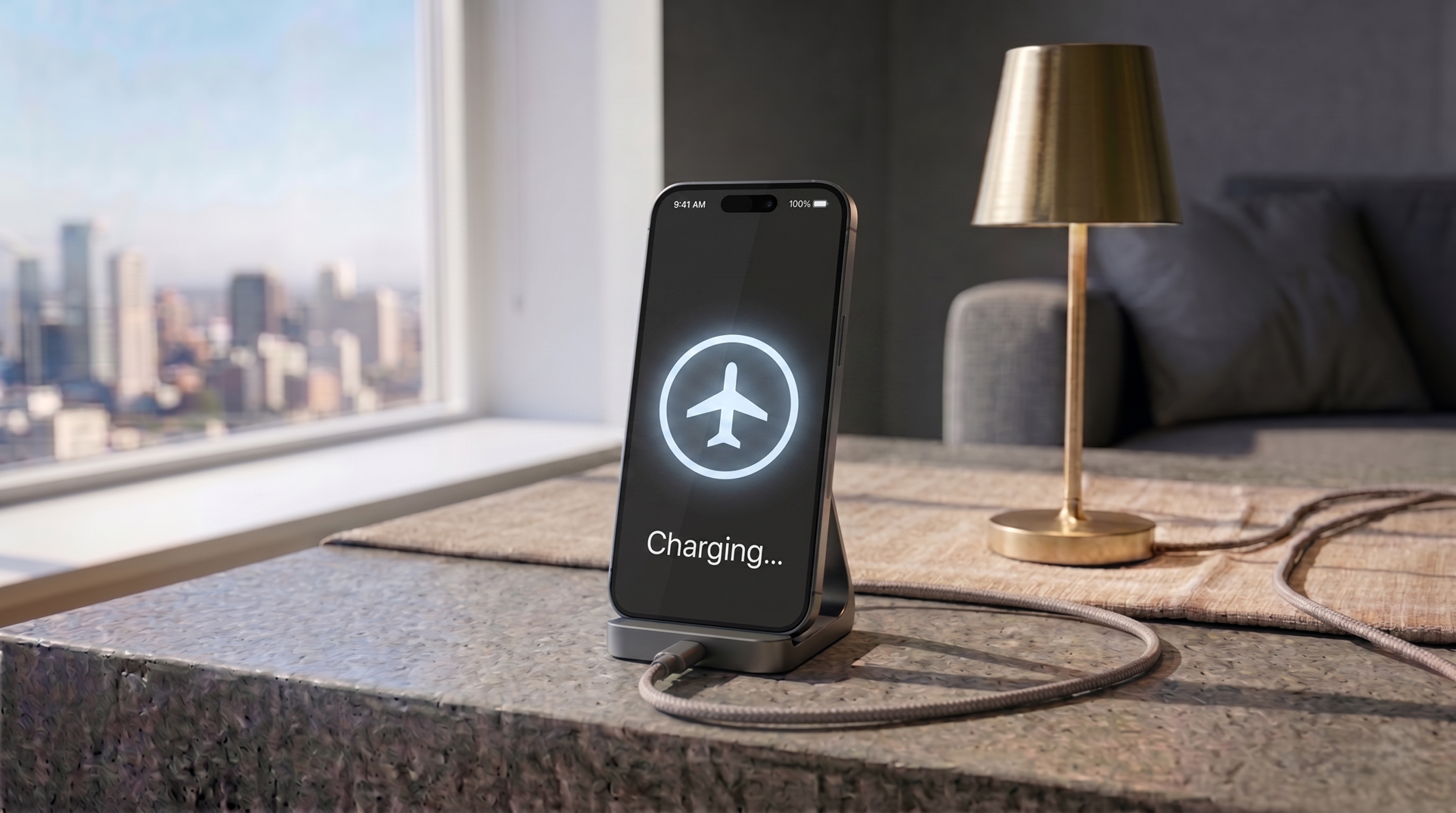
The advice circulates reliably: turn on Airplane Mode, and your phone will charge significantly faster. It’s one of those tips that gets passed around confidently, occasionally tested, and frequently misunderstood. Here’s what the data actually shows.
The mechanism—why it works at all
When your phone is in normal use, its cellular, Wi-Fi, and Bluetooth radios are continuously active—scanning for signals, maintaining connections, and processing background network activity. When you flip Airplane Mode on, you’re essentially giving your phone a break. Instead of dividing incoming power between charging and maintaining connections, nearly all the power flows straight to your battery.
This is a real effect. The question is how large it is in practice.
The actual numbers from independent testing
Testing shows that enabling Airplane Mode while charging reduces the time it takes to go from 0% to 100% by around 5 minutes on average, with the gap consistently hovering between 4 and 7 minutes across multiple test runs.
Broader testing puts the average improvement at 5–10% faster, depending on phone model, charger wattage, and signal conditions. One test on a Samsung Galaxy S22 found a 16% boost in charging speed—an outlier result, but illustrative of how much signal conditions affect the outcome.
When Airplane Mode actually makes a noticeable difference
The effect is most pronounced in two specific situations.
First, with slow chargers. With slow chargers or low-power USB ports—like those of many computers—the charging capacity is more limited, and any saving in internal power consumption translates better into actual minutes saved. On a 5W charger or a laptop USB port, the radio power draw represents a meaningful fraction of total power input.
Second, in areas with a weak signal. When your phone struggles to maintain a cellular connection, it increases transmission power to compensate—a process that consumes more battery than a phone in strong signal coverage. In high-drain scenarios, the difference can be more significant.
When it barely makes a difference
With fast chargers, there is practically no noticeable variation. When a charger is delivering 30W, 65W, or more, the power draw from the phone’s radios is a small fraction of the total input. The math doesn’t move enough to matter.
Modern phones with efficient processors also reduce the baseline radio power draw, which compresses the gap further.
What actually makes a bigger difference
Turning the screen off while charging has a more consistent impact than Airplane Mode in most scenarios—the display is typically the largest single power consumer on a phone. Not using the phone at all while it charges helps substantially. And using a fast certified charger rather than an old slow one addresses the actual bottleneck in most slow-charging situations.
While charging a phone in Airplane Mode may slightly improve charging times, the savings aren’t significant enough for most users to make it a habit.
The practical conclusion
Airplane Mode charging is real, not a myth. The improvement is real but modest, typically around 5–15% faster depending on your phone model and network conditions. If you’re using a fast charger in good signal coverage, the effect is negligible. If you’re charging from a slow source in a weak signal area and every minute counts, it’s worth using.