
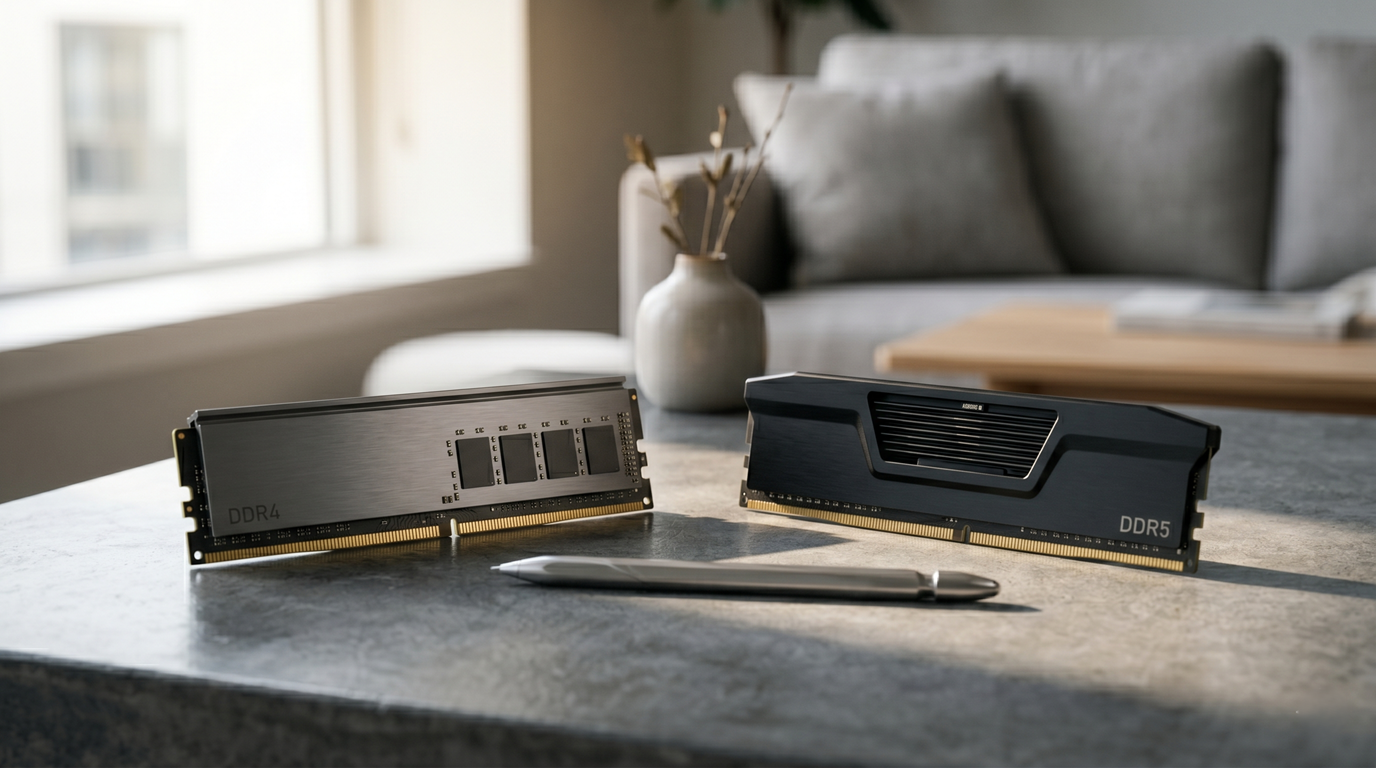
DDR5 has been the standard for new high-end and mid-range platforms since 2023, and prices have dropped significantly since its 2021 introduction. But whether you should switch from DDR4 depends on factors most comparison articles skip.
Your platform decides first
Before comparing speeds or prices, check what your CPU and motherboard actually support. This is the constraint that determines everything else.
Intel 12th, 13th, and 14th generation processors require DDR5 (with some 12th gen boards supporting both—check your specific model). AMD Ryzen 7000, 8000, and 9000 series processors require DDR5. Intel 11th generation and older, and AMD Ryzen 5000 series and older are limited to DDR4.
To check your current memory type, download CPU-Z (free at cpuid.com) and look at the Memory tab.
If you’re on an older platform, the question of DDR4 vs. DDR5 is answered: you use DDR4, and any upgrade should be within that standard.
The real performance difference
In gaming and general everyday use—browsing, productivity applications, typical multitasking—the performance difference between DDR4 and DDR5 at equivalent capacity is typically 3 to 8 percent. Most users won’t notice this in practice.
DDR5’s higher memory bandwidth produces more meaningful gains in specific workloads: video rendering and encoding, working with large datasets, running multiple virtual machines simultaneously, and compilation-heavy software development. For these tasks, DDR5 is the better choice on compatible platforms.
Pricing in 2026
DDR5 pricing has decreased substantially since 2021. The premium over equivalent DDR4 capacity is significantly smaller than it was at launch. That said, DDR4 still offers better value on a raw gigabyte-per-dollar basis—particularly for high-capacity configurations.
The practical recommendations
- Building a new system on a modern platform: choose DDR5. The price difference no longer provides sufficient justification for DDR4, and DDR5 is the forward-looking standard for this hardware generation.
- Upgrading an existing DDR4 system: add more DDR4 RAM rather than switching platforms. If you’re running 8GB, upgrading to 16 GB of DDR4 will produce a more noticeable improvement than switching to 16 GB of DDR5 on a new platform. Capacity matters more than memory type for everyday performance.
- Already on a DDR5 platform with sufficient capacity: consider speed and timings before worrying about the generation. DDR5-6000 with tight timings will outperform DDR5-4800 with loose timings more meaningfully than the generational gap between DDR4 and DDR5.
The key principle
Memory upgrades should address your actual bottleneck. Open Task Manager and check memory usage under your typical workload. If you’re regularly hitting 90%+ memory usage, more capacity is the priority. If usage is comfortable but performance feels slow, the RAM type is unlikely to be the limiting factor.